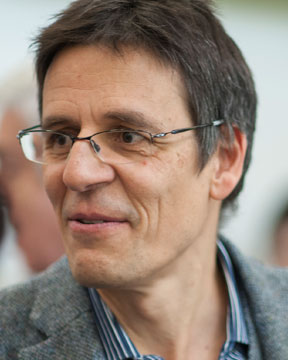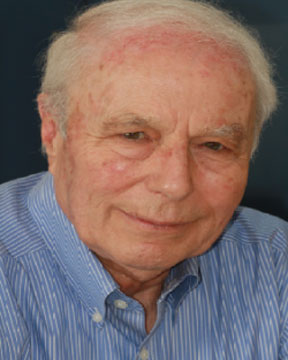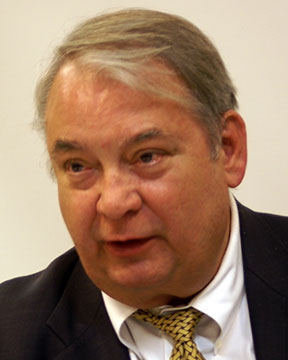

In Honor of Nobel Laureate Dr. Aaron Ciechanover



| SESSION: MathematicsThuPM2-R5 |
Kauffman International Symposium (8th Intl. Symp. on Sustainable Mathematics Applications) |
| Thu. 20 Nov. 2025 / Room: Orchid | |
| Session Chairs: Dmitri Alexandrov; Student Monitors: TBA | |
From the fact that the stretching of the elastically periodic Hooke chain (CH) is symmetrical relative to its center (odd symmetry), it follows that the coordinate of the center of gravity CH remains unchanged. This makes it possible to accurately solve the system of nonlinear equations for the stationary states of the FK model and select the ground state from them.
In 1938, the authors: Yakov Ilyich Frenkel and Tatyana Abramovna Kontorova (LFTI) put forward the Frenkel-Kontorova model (FK model) [1], which served as the basis for the creation of many theories of highly nonlinear processes [2].
The FK model is an elastically periodic chain of atoms (CH) in a periodic potential.
CH - is a one-dimensional sequence of N point atoms of masses m with coordinates {xi} and period β, interconnected by elastic springs with the law of elastic dispersion Φ(x). Φ(x) - most often this is Hooke's law,  .
.
The periodic potential V(x) has even symmetry and period a=1.
In most previous works [1,2], it was assumed N = ∞ that solutions would be simplified by eliminating boundary effects from consideration. As it turned out [3,4], this assumption is wrong - in the discrete FK model there is no small parameter 1/N, so it is necessary to find exact solutions taking into account the position of its boundary atoms.
The potential energy of the FK system has the form:

 (1)
(1)
where N is the number of atoms in the chain, N=2K+1; xi is the distance of the i-th atom to the center of the chain.
In [1] 
If β=0, then in the ground state of the FK model the point CH is at the minimum of the potential V(x=0). When β≠0 the position of the central atom does not change x0=0. The positions of the remaining atoms relative to the center are not even and are determined from a system of nonlinear equilibrium equations.
 - system of N equilibrium equations. Taking into account x-i = - xi, we have:


 (2)
(2)
At x0=0, all coordinates xi and β are functions of x1, x1 ∈ [0, 1], β ∈ [0, 1], therefore, solutions for the ground state of the FK model can be obtained by minimizing U(x1) with respect to x1 [3,4]. Comparing the exact solutions [3,4] with their continuum approximations [5], we found that the properties of the ground state of the discrete FK model coincide with the properties of its continuum approximation only in the homogeneity region.
The dynamics of an FK model with a modified law of spring dispersion Φ(x) is considered. Φ(x) has two local minima. A dynamic structural phase transition between them was observed.
In [1], the FK model (β=1) was written in the continuum approximation, after which an exact analytical solution was found for a soliton moving at speed w (Frenkel-Kontorova dislocation).
In [1] there is no answer to the question about the presence in the system of other non-dislocation solutions that are localized in space and do not decay in time.
Such solutions were found in exact numerical calculations.
Let us write the Hamiltonian as the sum of kinetic K and potential U energies, with the law of elastic dispersion of the general form:

 (1)
(1)
Let us consider not only Hooke’s law, but also a function that does not allow the intersection of atoms in space (x≠o), for example, with two local minima x≈α and x=1+β:
 (2)
(2)
Assuming discrete time - t = j h, j = 1.2 ..., where h is the time step - we have solutions to the system of Newton’s equations for the k-th CH atom of the form:


 (3)
(3)
System of equations (3) is an algorithm for constructing dynamic solutions of the FK model.
In [2], the “Chain” program with algorithm (2)-(3) constructs dynamic solutions of the FK model.
An example of a dynamic solution with Hooke's law of elastic dispersion is considered and in it an energy excitation that does not decay in time, moving with a non-uniform speed and with an energy lower than the rest energy of the dislocation, is found.
When considering the dynamics of the FK model [2]: - α=0.5, β=0, γ=0.044, V0=0.03, Δ=1, a phase transition from β- to α-phase was found, with a decrease in the size of the CH by almost two times.
Conclusions:
1 The dynamics of the FK model and the dynamics of its continuum approximation do not always and everywhere coincide.
2 For the original discrete model, the result of an exact solution of the string limit may turn out to be erroneous. For example, in [3] an exact expression was obtained for a statistical sum of the FK model in the continuum approximation. Based on the above, it can be argued that this solution is not applicable to the original FK model.
3 If we accept that in local field theories ∇φ - this is a gradient analogue of Hooke’s chain, then we assume that in the center of the black hole matter with a changed metric and with fields collapsing to the size ɑN is grouped.
| SESSION: ModellingThuPM3-R5 |
20th Intl. Symp. on Multiscale & Multiphysics Modelling of 'Complex' Material |
| Thu. 20 Nov. 2025 / Room: Orchid | |
| Session Chairs: Alexander Filonov; Aleksandr Ivanenko; Student Monitors: TBA | |
The DFK model is formed by replacing the external periodic potential of the FK model with a second elastically periodic chain of atoms. The properties of the FK and DFK models are basically the same, but the role of the boundary atoms of the DFK model in the structural phase transitions of the "commensurate- incommensurate " phase (IC) has increased. The IC transitions have become asymmetrical in parameter of incommensurate.
In 1938, the authors: Yakov Ilyich Frenkel and Tatyana Abramovna Kontorova (LFTI) put forward the Frenkel-Kontorova model (FK model) [1], which served as the basis for the creation of many theories of highly nonlinear processes [2].
It is of interest to develop the FK model in order to expand the scope of its natural science applications [3-4].
In order to develop the FK model, the DFK model (Developed Frenkel-Kontorova model) is put forward: - two one-dimensional sequences of N and L point atoms, masses m and M; with coordinates {xi} and {yj}, connected by elastic springs with the laws of elastic dispersion Φ1(x) and Φ2(y). Chains CH1 and CH2 interact with each other by potential Vi,j.
The Hamiltonian of the DFK model has the form:

 (1)
(1)
From the analysis of the ground state of the DFK model (N = L) [3], the following conclusion: - when one of the Hooke’s chains is stretched by force F, an abrupt transition to the incommensurate phase occurs (F>Fc), in which part of the atoms of the stretched chain CH1 leaves the interaction space with CH2. The number of atoms falling out of the Vi,j interaction space  , where V0 = max Vi,j.
With strong interaction (V0 ~ 1) and strong stretching (F>Fc ~1), the size of the dislocation is 2, and the number of precipitated atoms is N/2. In this case, the incommensurate phase will be a periodic chain of hole dislocations, i.e., commensurate crystal with doubled period.
FK, DFK models and a new theory of metal alloys are used to explain the Portevin-Le Chatelier effect.
Quote from [1,2]: -
“Many experiments measuring the deformation of solids under static loads have revealed sudden yielding and other deviations from normal behavior, now known as the “Portvin-Le Chatelier effect.” If we follow historical truth, then the honor of the discovery of this phenomenon should be associated with the names of Felix Savard (1837) and Antoine Philibert Masson (1841). Masson described a steep, almost vertical (σ-ε diagram) increase in stress, accompanied by very little deformation, up to a value at which there was a sudden sharp increase in deformation at constant stress. In experiments of this type with dead loads used in testing machines in the 19th century, this phenomenon took on the form that later led to the use of the term "staircase effect."
For small and large deformations, this effect has been studied by many over the past two centuries, but a satisfactory explanation has not yet been achieved.
It makes sense to compare the experimental ladders of the Portvin-Le Chatelier effect [1,2] with the already existing theoretical ladders [3,4].
In [1,2], in experiments on stretching AL with a purity of 99.99% shows several detailed graphs of the σ-ε dependence, for example, [1, p. 74] and [2, p. 288].
If you compare the staircase [1, p. 74] with the staircases [3,4], then their similarities are revealed - they almost coincide. But if you look at [1, p. 74] more carefully, especially at the initial stretching section, then qualitative differences are noticeable. First of all, this is the absence of strictly vertical segments in the experimental graphs. Consequently, the FK model is not enough to explain the EPLC, so it needs to be modified and replaced with the DFK model.
From the point of view of the DFK model, the initial stretching segment is associated with the general stretching of two CHs united by the potential Vlj. Further, at a certain critical force Fc, failure occurs with compression of CH2 and abrupt stretching of CH1 followed by interchain capture. The process is repeated until the sample breaks.
The first prediction of the new model is that when stretched, the sample becomes chemically inhomogeneous in length and composition of m and M atoms.
The most important question for the EPLC within the framework of the DFK model arises - the nature of Hooke's chains.
If stretchable CH1 is logically associated with an AL crystal, then the nature of CH2 may be associated with metal impurities. Let's follow this hypothesis.
In metals with a small number of impurities, for example, in ALR%, the metal impurity R% is capable of being ordered into a cubic crystal at high temperatures. Impurity period CH2 – one-dimensional projection of the crystal R% we evaluate as  , where % is the number of impurities in the main matrix. Suppose that in our case % = 10-6, then the period CH2 R ≈ 100.
Comparing the number of steps [1, p. 74] with R=100, we find an approximate match.
As a result of stretching, the period of the R-sublattice changes from r=100 to r=1.
From the temperature graphs of the EPLC [2] it is clear that the EPLC disappears at T> Tc.
EPLC is a special case of phenomena in metal alloys AxB1-x.
A sublattice model of metal alloys and the hypothesis that alloys are described by commensurate phases of the DFK model are put forward. The chemical composition of its grains is predicted for the AxB1-x alloy.
A metal alloy is a collection of crystalline grains with an average size R, the space between which is filled with impurities.
Classical theories of metal alloys are based on the idea of a “random phase”: - atoms in a crystal lattice according to chemistry composition can be arranged randomly.
The DFK model puts forward the idea of a “commensurate phase”, which is realized by the strong interaction of crystal sublattices: for example - an alloy AB of equiatomic composition is considered as a commensurate crystal with AB molecules (N = L). If the main periods of the sublattices are equal, respectively for crystal A - a, for crystal B - b, then the period of the AB alloy crystal is equal to  . When heated (T>V0), the sublattices become independent and return to the original periods (a, b).
Having asked the question about the atomic composition of the grain of the AxB1-x alloy, we proceed from the main hypothesis - metal alloys are described by commensurate phases of the DFK structure. Let us project an alloy of cubic symmetry AxB1-x (x≥0.5) onto a one-dimensional DFK model. Assuming that the alloy is a commensurate phase of the DFK model with CH(Ax) and CH(B1-x) sublattices and strong interchain interaction, V0~1 - we will show that x can only take discretely defined values x=x0.
To the alloy grain AxB1-x (x ≥ 0.5) we associate elastically periodic chains CH(Ax) and CH(B1-x) of N and L atoms of the same size, respectively, then if the period of the chain CH(Ax) = 1, then the period of the chain CH(B1-x) is equal to  .
.
Thus, x can only take discrete values x0:
 (1)
(1)
The chemical composition of the AxB1-x alloy grain has the form Ax0B1-x0. We choose in (1) the first fractional-rational values  ≥ 1, with the smallest denominators, because commensurate phases [1-4] with strong interaction can only be realized with them. From (1) we have: x0 = 0.50; 0.70; 0.89, i.e. very limited number of options depending on V0.
The dropped atoms, with density Δx=x-x0, are located between the grains, determining their size R:
R~1/ Δx. (2)
It is interesting to note that the chemical composition of many metal alloys AxB1-xC, with high-temperature superconductivity (HTS), lies near the values of x0 = 0.50; 0.77; 0.89; 0.96.
This suggests that HTS should be described by a model with incommensurate phases [1-3] and a chemical density wave. In this case the variance of R is minimal.
| SESSION: SolidStateChemistryThuPM2-R9 |
5th Intl. Symp. on Materials/Solid State Chemistry and Nanoscience for Sustainable Development |
| Thu. 20 Nov. 2025 / Room: Benjarong Main Rest | |
| Session Chairs: Alexander Filonov; Alexander Salyulev; Student Monitors: TBA | |
Crystals of diamond (C}, silicon (Si), and silicon carbide (SiC) were dissolved in KOH and NaOH, after which the alkalis were washed out with water.
Analytical measurements of the obtained mono clays: [diamond(C}; silicon (Si); quartz (SiO2); (SiC)] + H2O were carried out.
The purpose of the research is to test the hypothesis of a "nano dielectric molecule".
In [1], it was assumed that all dielectric crystals with cleavage planes can be chemically decomposed into a finite number of nanocrystalline blocks. In furtherance of this hypothesis, we conducted a series of experiments with crystals of diamond, silicon, and silicon carbide, similar to [2-6]:
1. After diamonds were dissolved in KOH and alkali was washed out with water, water-diamond (C- mono clay) was obtained [1-6].
2. After silicon single crystals were dissolved in KOH and NaOH and alkali was washed out with water, silicon (Si - mono clay) and quartz (SiO2 - mono clay) were obtained.
3. After dissolving silicon carbide crystals in KOH and washing out the alkali with water, SiC - mono clay was obtained.
By clay, we mean a semi-liquid substance consisting of crystals of various chemical compositions and water.
Mono-clay is a clay consisting of identical nano-dielectric crystals dissolved in water.
It turned out that the X-ray structure of mono clays is absent in the semi-liquid state, but it reappears during annealing.
Conclusions:
1. Dielectric crystals consist of identical nano blocks (nano dielectric molecules).
2. Dielectric crystals, after dissolving and washing out the solvent with water, turn into mono-clay of the corresponding crystal.