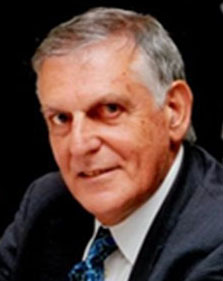

In Honor of Nobel Laureate Dr. Aaron Ciechanover


| SESSION: AdvancedMaterialsThuPM2-R6 |
9th Intl Symposium on New & Advanced Materials and Technologies for Energy, Environment, Health and Sustainable Development |
| Thu. 20 Nov. 2025 / Room: Jasmin | |
| Session Chairs: Fernand D. S. Marquis; Christoph Scherr; Student Monitors: TBA | |
The first step to design highly active nanomaterials for renewable energy applications under electrochemical media is clear understanding of structure—property-performance correlation. For example, solid-stat electrolytes play key role for safer operation of lithium-ion batteries, however, its undesirably low ionic conductivities have delayed commercial applications. Nanoscale electrocatalysts are key components for renewable energy conversion reactions, but till now none satisfy the three criteria of activity, selectivity and stability in active liquid media.
This presentation demonstrates a self-driving computational strategy to empower efficient and precise screening exploration of unknown candidates and exploitation of known materials, which are highly functional for energy storage and conversion reactions in electrochemical systems. Combined with first-principles DFT calculations and machine learning techniques with advanced algorithms we show that rigorous working principles for experimentally discovered nanomaterials can be elucidated. Moreover, design principles for even empowering higher performance are proposed. Most interestingly, several candidates are suggested, which can get over long-standing challenges to the nanomaterials applied to energy storage and conversion. As example, we show single atom catalysts, which are bi-functionally very active (oxygen reduction and oxygen evolution reactions) very active and allow the performance tunability according to target purpose.