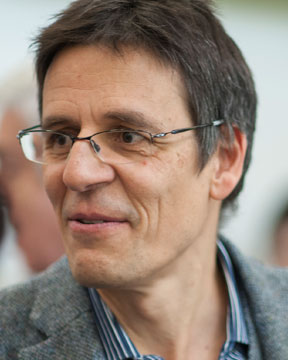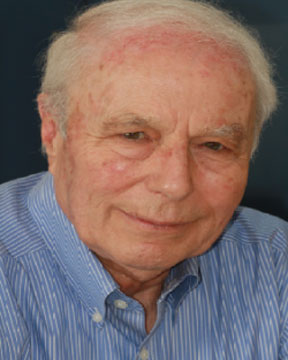

In Honor of Nobel Laureate Dr. Aaron Ciechanover



| SESSION: MedicineTuePM3-R9 |
4th Intl. Symp. on Technological Innovations in Medicine for Sustainable Development |
| Tue. 18 Nov. 2025 / Room: Benjarong Main Rest | |
| Session Chairs: Paata Kervalishvili; Olga Peryanova; Student Monitors: TBA | |
A theoretical and experimental search has been conducted for a model to explain the therapeutic effect of the "Philippine healer" - ultrafast healing of medical wounds. We came to the conclusion that the AIM+ - model is more suitable than the others. Previously [1-3] were presented: FK, DFK, AIM, AIM+ models.
The FK model is an elastic-periodic chain of atoms (CH1) in a periodic potential, which is described by commensurate and incommensurate phases.
In the DFK model, the periodic potential of the FK model is replaced by a second elastically periodic chain of atoms (CH2).
In the AIM model, the cosmological applications of the FK + DFK models are considered, through the creation of a time chain (CH1 + CH2), a type of open system.
The rubaiyat of Omar Khayyam voiced the cosmological idea of the AIM model:
“Oh, woe! Nothingness is embodied in our flesh,
Nothingness is surrounded by a border of celestial spheres.
We tremble in horror from birth to death:
We are ripples on Time, but it is nothing.”
In the AIM+ model, CH1 atoms returning to the jerk point form a cloud of gas, which condenses on the energy excitations of the time chain (CH1+ CH2), forming associated states with them.
Let us call the emerging states “living cells” (LC). LCs can be two-dimensional, three-dimensional, etc. It is possible that the first three-dimensional LC was formed at the stage of inflationary growth of the Universe long before the point of the “Big Bang”; let’s call it “inflaton”.
AIM+ model considers the phase of inflationary growth of the Universe as the initial stage of the development of a microbial colony.
It is known that communities of biological cells are open biological systems, which at the initial stages develop according to an exponential law (I-phase). But then they plateau very quickly. We believe that the I-phase can be extended by creating a coherent state for the LC (CR mode), when the entire community develops coherently.
In experiments [4, 5] the problem of creating one of the possible CR modes in microbiological systems was solved: - stimulating the growth of a colony of a microbiological culture of e.coli with a physical device with spatial coherence, by resonantly matching the size of a biological cell with the coherence period of the device. As a result: - we observed CR stimulated by an external field - modes with single and multiple subcultures of the microbiological culture.
| SESSION: MathematicsThuPM2-R5 |
Kauffman International Symposium (8th Intl. Symp. on Sustainable Mathematics Applications) |
| Thu. 20 Nov. 2025 / Room: Orchid | |
| Session Chairs: Dmitri Alexandrov; Student Monitors: TBA | |
A dynamic theory of ordering of the DFK hole dislocations is put forward.
The results of the developed FK and DFK models are incorporated into the AIM theory to answer the question: how does the process of ordering dislocations of the DFK model proceed into a commensurate crystal?
Consider the DFK model, a system of two N atomic elastically periodic chains (A, B).
Let the elasticity of the springs of chain (B) be equal to infinity, and opposite forces are applied to the ends of chain (A) by jerk. As a result of a strong jerk  atoms of chain A leave the region of interaction with chain B, and a commensurate crystal with a doubled period is formed. Each element of this crystal is a Frenkel-Kontorova hole dislocation (FK) [1].
An FK is a formation that has a number of properties that coincide with the characteristics of a point particle, namely: – mass M; incompressible size equal to 2; kinetic and potential energy, etc.
A commensurate crystal after a jerk is not formed immediately, but as atoms fly out of the region of interaction of chains, during the movement of dislocations to the center of the system.
On a chain (length N), dislocations appear at its edges and are arranged in pairs symmetrically relative to the center.
It is of interest to write down the spatiotemporal equation of the FK ordering process, starting from the departure of the first two edge atoms of the stretched chain to the departure of its last L atoms.
Let us associate the emitted J-atom of the DFK chain with a dislocation with number J at its end, J≤J0, J0 = L/2. The remaining FK dislocations numbered i, 1 ≤ i < J, are located between the center of the chain and its edge. FK move towards the center of the chain.
We will describe the dynamics of dislocation ordering depending on the number of the ejected J-atom using the AIM model.
The theory states:
1. DFK dislocation with number i is an analogue of the i-th moment of time, located at the moment of time J at a distance  from the center of the system.
2. R(J) - discrete Lagrangian of the AIM model.
R(J) has the form:

(1)
3.  determined from the equation:
 (2)
(2)
4. Our goal is to find all values of  ; 1≤ i 0,
  , with the final solution:
 (3)
(3)
where L is the main parameter of the model.
5. Parameters MJ, V(J) are found from the system of inequalities:


 (4)
(4)
where MJ is the mass of atoms in a chain of 2J dislocations, atoms are called DFK dislocations;  - period of an elastic-periodic chain, with an elasticity coefficient equal to 1;
V(J) is the periodic potential in which the dislocation chain is located.
From the fact that the stretching of the elastically periodic Hooke chain (CH) is symmetrical relative to its center (odd symmetry), it follows that the coordinate of the center of gravity CH remains unchanged. This makes it possible to accurately solve the system of nonlinear equations for the stationary states of the FK model and select the ground state from them.
In 1938, the authors: Yakov Ilyich Frenkel and Tatyana Abramovna Kontorova (LFTI) put forward the Frenkel-Kontorova model (FK model) [1], which served as the basis for the creation of many theories of highly nonlinear processes [2].
The FK model is an elastically periodic chain of atoms (CH) in a periodic potential.
CH - is a one-dimensional sequence of N point atoms of masses m with coordinates {xi} and period β, interconnected by elastic springs with the law of elastic dispersion Φ(x). Φ(x) - most often this is Hooke's law,  .
.
The periodic potential V(x) has even symmetry and period a=1.
In most previous works [1,2], it was assumed N = ∞ that solutions would be simplified by eliminating boundary effects from consideration. As it turned out [3,4], this assumption is wrong - in the discrete FK model there is no small parameter 1/N, so it is necessary to find exact solutions taking into account the position of its boundary atoms.
The potential energy of the FK system has the form:

 (1)
(1)
where N is the number of atoms in the chain, N=2K+1; xi is the distance of the i-th atom to the center of the chain.
In [1] 
If β=0, then in the ground state of the FK model the point CH is at the minimum of the potential V(x=0). When β≠0 the position of the central atom does not change x0=0. The positions of the remaining atoms relative to the center are not even and are determined from a system of nonlinear equilibrium equations.
 - system of N equilibrium equations. Taking into account x-i = - xi, we have:


 (2)
(2)
At x0=0, all coordinates xi and β are functions of x1, x1 ∈ [0, 1], β ∈ [0, 1], therefore, solutions for the ground state of the FK model can be obtained by minimizing U(x1) with respect to x1 [3,4]. Comparing the exact solutions [3,4] with their continuum approximations [5], we found that the properties of the ground state of the discrete FK model coincide with the properties of its continuum approximation only in the homogeneity region.
The dynamics of an FK model with a modified law of spring dispersion Φ(x) is considered. Φ(x) has two local minima. A dynamic structural phase transition between them was observed.
In [1], the FK model (β=1) was written in the continuum approximation, after which an exact analytical solution was found for a soliton moving at speed w (Frenkel-Kontorova dislocation).
In [1] there is no answer to the question about the presence in the system of other non-dislocation solutions that are localized in space and do not decay in time.
Such solutions were found in exact numerical calculations.
Let us write the Hamiltonian as the sum of kinetic K and potential U energies, with the law of elastic dispersion of the general form:

 (1)
(1)
Let us consider not only Hooke’s law, but also a function that does not allow the intersection of atoms in space (x≠o), for example, with two local minima x≈α and x=1+β:
 (2)
(2)
Assuming discrete time - t = j h, j = 1.2 ..., where h is the time step - we have solutions to the system of Newton’s equations for the k-th CH atom of the form:


 (3)
(3)
System of equations (3) is an algorithm for constructing dynamic solutions of the FK model.
In [2], the “Chain” program with algorithm (2)-(3) constructs dynamic solutions of the FK model.
An example of a dynamic solution with Hooke's law of elastic dispersion is considered and in it an energy excitation that does not decay in time, moving with a non-uniform speed and with an energy lower than the rest energy of the dislocation, is found.
When considering the dynamics of the FK model [2]: - α=0.5, β=0, γ=0.044, V0=0.03, Δ=1, a phase transition from β- to α-phase was found, with a decrease in the size of the CH by almost two times.
Conclusions:
1 The dynamics of the FK model and the dynamics of its continuum approximation do not always and everywhere coincide.
2 For the original discrete model, the result of an exact solution of the string limit may turn out to be erroneous. For example, in [3] an exact expression was obtained for a statistical sum of the FK model in the continuum approximation. Based on the above, it can be argued that this solution is not applicable to the original FK model.
3 If we accept that in local field theories ∇φ - this is a gradient analogue of Hooke’s chain, then we assume that in the center of the black hole matter with a changed metric and with fields collapsing to the size ɑN is grouped.
| SESSION: ModellingThuPM3-R5 |
20th Intl. Symp. on Multiscale & Multiphysics Modelling of 'Complex' Material |
| Thu. 20 Nov. 2025 / Room: Orchid | |
| Session Chairs: Alexander Filonov; Aleksandr Ivanenko; Student Monitors: TBA | |
As shown earlier:


* (AIM- ab initio mundu (lat.) – from the beginning of the world).
Thus, the AIM theory is an open FK model with an increasing number of particles and with “running” ones, i.e. J-dependent; periods, masses and potential amplitudes.
In systems with periodic potentials, inhomogeneous dynamic solutions inevitably arise that are not destroyed. Consequently, in a system with potential (1) it is impossible to obtain a homogeneous solution as the final result.
In this regard, it is necessary to introduce additional terms into Lagrangian (1), ensuring the destruction of nonlinear excitations. We believe that the initial terms of the “destruction mechanism” should be the first and second harmonics V(J) with the main and doubled periods alternating on (off) depending on the parity of J.
We expect that in a system with the first and second harmonics alternately turning on (off) the previous one-dimensional solitons stop, but over time two-dimensional non-decaying dynamic excitations are formed.
After some time JK ~ J0 in (1), the following harmonics VK(J) are turned on (off). At points J = JK on the temporary dislocation chain of the AIM system, phase transitions occur with a change in the spatial dimension of dynamic excited states.
To summarize, for the AIM model we write: (1),
where  is the “destruction mechanism”, with each moment of time divided into K-instants, with the corresponding harmonics of the external potential.
From general considerations it follows that VK(J) ~ V0(J), V0(J0) = 0. The phase transition points JK are determined by inequalities (1).
From a cosmological point of view, the number of moments of the time is equal to the optimally round number, i.e.  .
.
Let’s compare the generally accepted concepts with the concepts of the AIM model:
1. “Matter” – energy excitations on the time chain;
2. “Dark energy” - one-dimensional phase of matter (stationary);
3. “Dark matter” - two-dimensional phase of matter (stationary);
4. “Visible matter” - three-dimensional phase of matter (dynamic);
5. The next phase is four-dimensional, etc.
Let us estimate the phase composition of matter at different stages of the development of the Universe.
Let X be the dynamic weight part of the Universe, then for a state of K phases we write:
X+KX+K2X+K3X+…+KK-1X=1; those. X= (K-1)/(KK-1).
When K=3, X+3X+9X=1; X3≈8%. Based on estimates of modern cosmology, for time intervals Tk we have:
T3=30 billion years; T2=90 billion years; T1=180 billion years; T4=7.5 billion years; T5=1.5 billion years...; T = ∑Tk ≈ 310 billion years.
The AIM+ model assumes the return of the emitted atoms of the DFK –chain to the point of their departure, with the formation of two interacting subsystems in the AIM model.
| SESSION: SolidStateChemistryThuPM2-R9 |
5th Intl. Symp. on Materials/Solid State Chemistry and Nanoscience for Sustainable Development |
| Thu. 20 Nov. 2025 / Room: Benjarong Main Rest | |
| Session Chairs: Alexander Filonov; Alexander Salyulev; Student Monitors: TBA | |
Crystals of diamond (C}, silicon (Si), and silicon carbide (SiC) were dissolved in KOH and NaOH, after which the alkalis were washed out with water.
Analytical measurements of the obtained mono clays: [diamond(C}; silicon (Si); quartz (SiO2); (SiC)] + H2O were carried out.
The purpose of the research is to test the hypothesis of a "nano dielectric molecule".
In [1], it was assumed that all dielectric crystals with cleavage planes can be chemically decomposed into a finite number of nanocrystalline blocks. In furtherance of this hypothesis, we conducted a series of experiments with crystals of diamond, silicon, and silicon carbide, similar to [2-6]:
1. After diamonds were dissolved in KOH and alkali was washed out with water, water-diamond (C- mono clay) was obtained [1-6].
2. After silicon single crystals were dissolved in KOH and NaOH and alkali was washed out with water, silicon (Si - mono clay) and quartz (SiO2 - mono clay) were obtained.
3. After dissolving silicon carbide crystals in KOH and washing out the alkali with water, SiC - mono clay was obtained.
By clay, we mean a semi-liquid substance consisting of crystals of various chemical compositions and water.
Mono-clay is a clay consisting of identical nano-dielectric crystals dissolved in water.
It turned out that the X-ray structure of mono clays is absent in the semi-liquid state, but it reappears during annealing.
Conclusions:
1. Dielectric crystals consist of identical nano blocks (nano dielectric molecules).
2. Dielectric crystals, after dissolving and washing out the solvent with water, turn into mono-clay of the corresponding crystal.