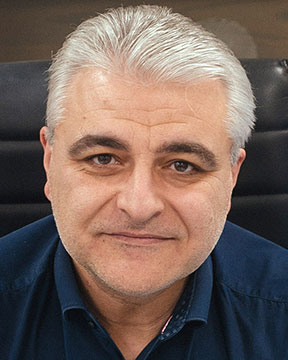

In Honor of Nobel Laureate Dr. Aaron Ciechanover



| SESSION: PolymersThuPM2-R4 |
Matyjaszewski International Symposium (5th Intl. Symp. on Green Chemistry & Polymers & their Application for Sustainable Development) |
| Thu. 20 Nov. 2025 / Room: Sampaguita | |
| Session Chairs: Jiajun Yan; Student Monitors: TBA | |
Deep eutectic solvent (DES)-based eco-friendly technologies for the isolation of lignin from lignocellulosic waste biomass have gained significant attention as sustainable alternatives to conventional extraction methods [1,2,3]. The present work aims to improve the yield of lignin extracted from pomegranate and banana peel biowastes using green choline chloride-oxalic acid (CC-OA) DES by optimizing the extraction parameters using response surface methodology approach. An empirical quadratic model was formulated using Response Surface Methodology based on Central Composite Design to optimize the yield of lignin from pomegranate and banana peel bioresources, respectively. The study revealed that the maximum lignin yield of 39.5% and 55.52% was obtained from pomegranate peel and banana peel using the green DES. This study further demonstrated that the yield of lignin is strongly impacted by reaction time, temperature, solvent-to-biomass ratio and CC:OA ratio. The lignin obtained with maximum yield under optimized condition was comprehensively characterized by Fourier Transform Infrared Spectroscopy, UV-Visible spectroscopy, Environmental Scanning Electron Microscopy, X-Ray Diffraction, 1H and 2D Nuclear Magnetic Resonance spectroscopy to confirm its structural and morphological properties. Overall, the yield of lignin recovered from fruit wastes was enhanced by optimizing the DES extraction parameters through response surface methodology.
| SESSION: BiomaterialsThuPM1-R6 |
International Symposium on Biomaterials for Sustainable Development |
| Thu. 20 Nov. 2025 / Room: Jasmin | |
| Session Chairs: Hassane Oudadesse; Krishna Pramanik; Student Monitors: TBA | |
Corneal epithelial tissue regeneration presents a significant clinical challenge due to its avascular nature and complex structural organization. In recent years, developing polymeric composite material with desired optical transparency, tensile strength, biodegradability, porosity and corneal tissue responsive properties for repairing the damaged corneal epithelium is striving. By integrating biomimetic cues, such as ECM-derived peptides, flavonoids, and growth factors with polymeric blends, the resulting biomaterials are tailored thereby smart biomaterials can be developed to facilitate corneal epithelial regeneration. This research illustrates the designing of a biomaterial from the cocktail of silk fibroin, gelatin and polycaprolactone tri-polymeric complex functionalized with plant extract like curcumin that possesses the desirable properties suited for corneal epithelial tissue engineering applications. This biocomposite was used to fabricate a two-dimensional matrix which mimics the native extracellular matrix of corneal epithelium by electrospinning technique. The developed matrix was demonstrated to have desired tensile strength, in vitro biodegradability, controlled swelling, porosity, antimicrobial and antioxidant properties. The in vitro biocompatibility of the matrix revealed that the biomaterials promotes cellular attachment, growth and differentiation of SIRC (Statens Seruminstitut rabbit cornea) cell line. This lecture will discuss on multidisciplinary strategy to develop a smart biomaterial with desired biomimetic properties for effective corneal epithelial tissue regeneration by citing the above research as an example.