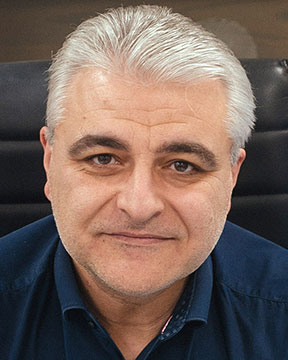

In Honor of Nobel Laureate Dr. Aaron Ciechanover


| SESSION: AdvancedMaterialsTuePM3-R6 |
9th Intl Symposium on New & Advanced Materials and Technologies for Energy, Environment, Health and Sustainable Development |
| Tue. 18 Nov. 2025 / Room: Jasmin | |
| Session Chairs: Marcela Pokusova; Konrad Swierczek; Student Monitors: TBA | |
Among the leading candidates for efficient energy conversion, Solid Oxide Fuel Cells (SOFCs) and Solid Oxide Electrolyzer Cells (SOECs) enable, respectively, the utilization of (green) hydrogen for electricity and heat generation, and production of hydrogen and other e-fuels from surplus renewable energy [1]. However, their large-scale application is still limited by unresolved challenges, particularly long-term stability issues and sluggish kinetics of the oxygen reduction (ORR) and oxygen evolution (OER) reactions at lowered operating temperatures [2]. Current research therefore focuses on tailoring both chemical composition and oxygen electrode morphology, with the aim of simultaneously enhancing electrochemical performance and stability, especially for reversible cell operation [3]. The family of double perovskites with the general formula AA’B2O5+δ (A: lanthanides; A’: alkaline earth metals, typically Ba; B: 3d metal elements, usually, with high amount of Co) represents attractive properties for oxygen electrodes in SOCs [4].
In this study, a series of Gd1-xSmxBa0.5Sr0.5CoCuO5+δ (0 ≤ x ≤ 1) (GSBSCCO) double perovskites were synthesized via sol-gel method and evaluated with respect to their structural and transport properties. Among them, the Gd0.75Sm0.25Ba0.5Sr0.5CoCuO5+δcomposition exhibited the lowest polarization resistance (Rp = 0.087 Ω cm-2 at 800 °C), as determined by electrochemical impedance spectroscopy (EIS). Owing to this promising performance, this composition was further synthesized in the form of nanofibers via electrospinning, since such architectures are known to promote mass and charge transport [5]. Surprisingly, enhancement of the electrochemical performance of the GSBSCCO|LSGM|GSBSCCO symmetrical cell, where La0.8Sr0.2Ga0.8Mg0.2O3-δ(LSGM) was used as the solid electrolyte, was observed only when Ce0.9Gd0.1O2-δ (GDC) was applied as a functional buffer layer. To better understand this phenomenon, a distribution of relaxation times (DRT) analysis of the EIS data was carried out, providing deeper insight into the performance of the electrodes and allowing for the identification of rate-limiting steps of electrochemical processes. The final step was to evaluate electrodes in the anode-supported button-type single cell with a Ni-Zr0.92Y0.08O2-δ (YSZ) anode, YSZ electrolyte and GDC buffer layer. The considered cell achieved power densities of 0.46 W cm-2 and 0.42 W cm-2 at 700 °C with electrospun and sol-gel electrodes, respectively.
In recent years, there has been a growing interest in the use of solid oxide cells (SOCs) for the high-temperature co-electrolysis of CO2 and H2O, particularly when powered by excess electricity from renewable energy sources. This technology is regarded as one of the most promising for sustainable energy systems, offering high efficiency and the ability to generate syngas, a versatile intermediate for synthetic fuels and chemicals. Moreover, it enables efficient energy storage and the use of CO2 as a feedstock, aligning with circular economy principles and supporting deep decarbonization. High-temperature co-electrolysis in SOCs stands out compared to low-temperature electrolyzers by also enabling CO2 conversion, although it requires advanced catalysts and optimized operating conditions to avoid issues such as carbon deposition [1-3].
This paper presents the current state of research on catalytic materials and system configurations for the high-temperature co-electrolysis of H2O and CO2 in reversible SOCs. Key scientific challenges discussed include understanding the physicochemical nature of the co-electrolysis process on the fuel electrode and identifying the limiting factors of performance and stability. Development of advanced nanostructured catalysts, particularly those based on fluorite- and perovskite-type oxides, as well as composite systems that offer enhanced reactivity and chemical compatibility with Ni-YSZ cermets and YSZ electrolytes is presented. In addition to the material design, process optimization strategies such as catalyst infiltration into cells and electrode surface engineering are explored to improve the electrochemical performance and long-term durability. The work highlights the emerging methodologies and engineering pathways that form the foundation for next-generation high-efficiency co-electrolysis systems, while outlining the prospects for scalable implementation and integration with renewable energy technologies.