
FLOGEN Logo
In Honor of Nobel Laureate Dr. Aaron Ciechanover

SIPS 2025 logo
SIPS 2025 takes place from November 17-20, 2025 at the Dusit Thani Mactan Resort in Cebu, Philippines

Honoree Banner

More than 400 abstracts submitted from over 50 countries
Abstracts Still Accepted for a Limited Time


Featuring many Nobel Laureates and other Distinguished Guests


Back

HOW COME THE QUANTUM? TESTING THE TOPOLOGICAL ORIGIN OF PLANCK'S QUANTUM OF ACTION
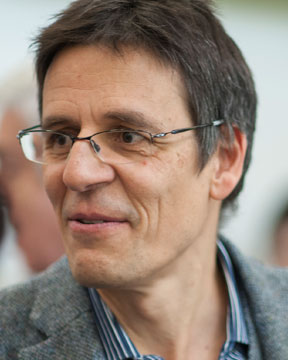
Louis Kauffman1; Christoph Schiller2
1University of Illinois at Chicago, Chicago, United States; 2Motion Mountain, Munich, Germany

PAPER: 349/Mathematics/Regular (Oral) OL
SCHEDULED: 15:25/Wed. 19 Nov. 2025/Dusit 3

ABSTRACT:

The answer to Wheeler's question ``How come the quantum?'' given by Kauffman is presented and explored. The answer, going back to an approach by Dirac, proposes a topological origin of Planck's quantum of action h-bar. The proposal assumes that space, particles and wave functions consist of unobservable strands of Planck radius, and that their crossing switches define h-bar. The proposal is checked against all quantum effects, including non-commutativity, spinor wave functions, entanglement, Heisenberg's indeterminacy relation, and the Schrödinger and Dirac equations. The principle of least action is deduced. The spectra of elementary particles, the gauge interactions, and general relativity are derived. Estimates for elementary particle masses and for coupling constants, as well as numerous experimental predictions are deduced. Complete agreement with observations is found. The derivations also appear to eliminate alternatives and thus provide arguments for the uniqueness of the proposal.

REFERENCES:
[1] L Kauffman and C Schiller, How come the quantum? Testing a proposal for the origin of Planck's quantum of action explaining wave functions, entanglement, least action,particle masses and coupling constants (2025), presentation slides at https://www.researchgate.net/publication/395337365
[2] L Kauffman and C. Schiller, How come the quantum? Testing the topological origin of Planck's quantum of action (to appear)
[3] C. Schiller, Testing a model for emergent spinor wave functions explaining elementary particles, gauge interactions and fundamental constants (2025), preprint at https://www.researchgate.net/publication/361866270
[4] C. Schiller, Testing the uniqueness of a unified description of motion based on topology and geometry (2025), preprint at https://www.researchgate.net/publication/389673692