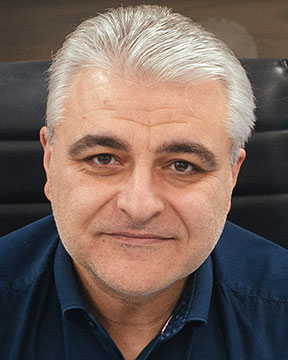

In Honor and Memory of Nobel Laureate Dr. Rudy Marcus
(Passed away on July 16, 2026)
(To Be Updated)
(Passed away on July 16, 2026)
(To Be Updated)




 |
Dr. Michael IbisonUniversity of San DiegoDirect Particle Interaction: Everything Is Connected — Including The Future Ord International Symposium (9th Intl. Symp. on Sustainable Mathematics Applications) Back to Plenary Lectures » |
Abstract:Direct particle interaction (DPI) — the action-at-a-distance electrodynamics of Schwarzschild, Tetrode and Fokker, developed by Wheeler and Feynman and later by Hoyle and Narlikar — holds that there are no fields, only charges, each acting on every other along the light cone, half into the past and half into the future. The programme was set aside rather than refuted, and there are now reasons to take it up again. This talk presents them. Field theory and DPI embody opposite intuitions. A field separates: it is a local medium standing between charges, with degrees of freedom of its own, allowing each charge to be described without reference to the others. DPI connects: the elementary object is the exchange between a pair of charges, and a particle is the sum of its connections. Field theory needs a spacetime canvas on which fields are painted; DPI needs only the invariant intervals between events on worldlines. I will argue that this inverts the usual order of explanation — spacetime is not the stage on which interactions occur but the structure that the totality of interactions defines, as distance in a graph is defined by its links — and that physics is then the theory of a network, with the local causal field as the coarse-grained view of that network from one of its nodes. Wheeler and Feynman made the theory’s standing depend on complete absorption, the condition under which the time-symmetric exchange reproduces purely retarded radiation. I will present a derivation of the Dirac equation from DPI in which this condition has a different and lower status. The derivation works with the adjunct potential of the rest of the universe acting on a single charge on both its forward and backward light cones; the local electron responds to the response of everything else, and the Dirac wavefunction emerges as a bilinear accounting of advanced and retarded connections, with the electron mass set by the frequency of that potential. Time-symmetric exchange is thereby placed at the foundation of quantum mechanics rather than being something that quantum mechanics must be protected from, and the nonlocality of quantum mechanics becomes the visible trace of the connections from which both particles and spacetime are built. The absorber question does not disappear; it changes form. Wheeler and Feynman did not examine the possibility that emission is directed towards the absorber — that radiation into what conventional theory treats as empty space, and expects to be isotropic, is in general not quite so. I will suggest that this is a prediction of DPI with an observable signature, and that the reported coherent alignments, over gigaparsec scales, of the optical polarization vectors of quasars and of the axes of radio jets — effects that are currently unexplained — may be evidence of it. |
|