FLOGEN Logo
In Honor of Nobel Laureate Dr. Rudy Marcus

(Under Construction)
SIPS 2026 logo
SIPS 2026 takes place from November 17-20, 2025 at the Dusit Thani Mactan Resort in Cebu, Philippines


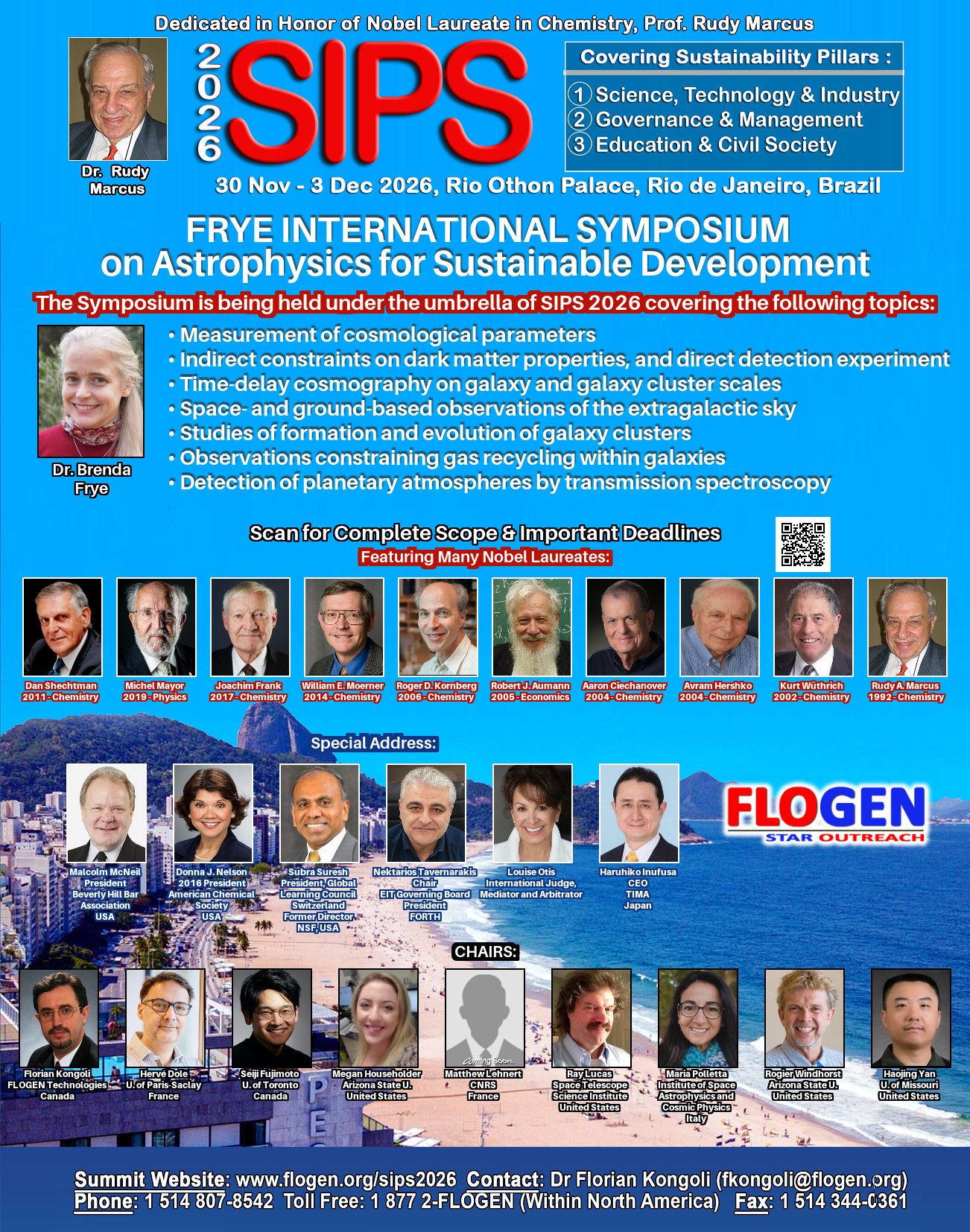
Featuring Many Nobel Laureates and Other Distinguished Guests

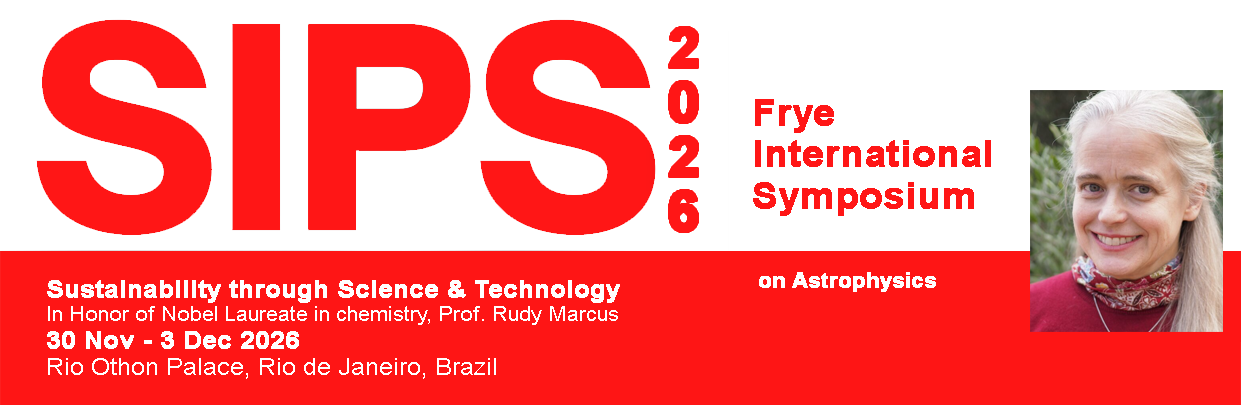
FRYE INTERNATIONAL SYMPOSIUM

on Astrophysics for Sustainable Development


Brenda_Frye
Bio | CV | Publications
This symposium commemorates the distinguished work and lifetime achievements of Professor Brenda L. Frye, a prominent astronomer who is known for her contributions to the field of observational astrophysics and cosmology. Currently she holds the position of Professor of Astronomy at the University of Arizona.

Her research ranges from the search for the apparently brightest stars and galaxies in the universe, to constraining properties of the mysterious dark matter, and to measuring the current rate of expansion of the universe. She has earned numerous accolades and honors for her scientific achievements along the way.

Born the same year humans landed on the Moon, Frye has dedicated her life to pushing the frontiers of scientific knowledge. Frye began her career in Astrophysics as a postdoctoral scholar at Lawrence Berkeley National Laboratory (LBNL) under the direction of Physics Nobel Laureate Professor Saul Perlmutter. Her career trajectory continued to rise upward by being awarded two prestigious postdoctoral fellowships at Princeton University. She expanded her research horizons by taking on her first professorship at Dublin City University in Ireland, and has also held professorships at University of San Francisco, and University of Arizona. This academic journey has been illuminated by a sense of enthusiasm in the pursuit of knowledge.

On the education front, Frye was awarded a National Science Foundation (NSF) Graduate Student Research Fellowship while still a Ph.D. student at the University of California at Berkeley. Prior to that, she earned two B.S. degrees at the University of Arizona in Physics and in Astronomy, magna cum laude, where she also received the honors of “Outstanding Senior” from both the Department of Astronomy and the College of Science. This educational achievement laid down a strong foundation on which to build her future research programs.

Frye is highly recognized for her work on the investigations of gravitational lenses, or natural magnifying optics in space. The most powerful gravitational lenses magnify, brighten up, and in some cases photocopy the images of the galaxies situated behind them. This is useful for two reasons: (1) to detect the dominant but invisible dark matter component in the lens, and (2) to discover and study some of the earliest and youngest galaxies in the universe. In the field of gravitational lensing, she made a ground-breaking discovery that confronts the standard model that describes our universe.

Frye exemplified a new approach using space-based observations to find the most massive gravitational lenses, the so-called cluster lenses. A cluster lens consists of dozens of galaxies of 10 billion stars each and an even more massive and underlying dark matter component.

Dark matter is a mysterious substance that is invisible to direct detection, and can be investigated through the gravitational lensing effect. The galaxy light incident on a gravitational lens gets stretched into a distorted version. These distorted galaxy image imprints are then used as constraints to reverse-engineer the dark matter distribution of the lens. While maps of this dark matter may seem beyond all practical concern, dark matter is incident on our own planet, and even governs the motion of the Sun through space. Frye’s work helps us to get one step closer towards understanding its nature.

Frye pioneered the use of cluster lenses as tools to study the objects behind them. For example, Frye discovered a single exploding star that was rendered into three different images of itself by the lensing effect. This meant that the viewer on Earth had the rare vantage point to see this supernova at three different times during its explosion.

The pinnacle of her work occurred by leveraging this discovery to extract cosmological information. This supernova was both gravitationally-lensed and had a known intrinsic brightness. Given a measurement of the difference in the arrival time of the light to each image, combined with the lens model, the current rate of expansion of the universe was measured for this first time in history for a multiply-imaged standard candle. Frye’s achievements in this domain had phenomenal impact by opening the door to a new test of the hot “Big Bang” model that describes our universe.

Frye’s career is characterized by innovation, persistence, and investment in the potential of young scientists. Her impact on the scientific world extends beyond awards and honors. She boasts an extensive publication record with over 300 publications, showcasing the depth and breadth of her contributions to the scientific literature. In addition, she has mentored more than 50 young scientists in postgraduate work covering two continents, investing her time to pass on scientific knowledge to the next generation.

In terms of professional service, Brenda Frye actively engages with the scientific community. She has served on advisory boards for international observatories and funding agencies, served on selection committees for Honorary Doctoral degrees and other awards, and has acted as a reviewer for manuscripts and telescope time. She also initiated an investigation with experts on international law on the advantages of establishing a sustained presence in space, positing that the perspective gained by such activity may provide the impetus needed to understand how to live sustainably on our own planet.

ROUND TABLE DISCUSSIONS
A round table discussion open to everyone interested will be organized during the symposium. This will allow high level representatives of various industries, technologies, and academic disciplines to discuss and debate freely, without reservations, all topics of this symposium and identify possible research and development pathways towards a future industry with increased sustainability.

You are cordially invited to actively participate in this symposium by submitting and presenting a paper, or by attending the round table. We look forward to meeting you at this world class symposium.

Click here to see the detailed scope and topics.
To download Flyer, click on the icon:
Click here to submit an abstract and choose Frye International Symposium (Intl. Symp. on Astrophysics for Sustainable Development) in the list: https://www.flogen.org/sips2026/abstract_submission.php?p=35#content_top
Click here to see the General Author Invitation: https://www.flogen.org/sips2026/invitations/Astrophysics_General_Author_Invitation.html
Click here to see the Social Media Text: https://www.flogen.org/sips2026/socialmediatext/Astrophysics_Social_Media_Text.html
Click here to see other resources for this symposium: https://www.flogen.org/sips2026/symresources.php?sym=84

CHAIRS

../sips2023/img3/thumbs_39.jpg
Dr. Florian Kongoli
CEO/President
FLOGEN Technologies
Canada, [Bio]
../sips2025/user_images/thumbs_6539.jpg
Dr. Megan Householder
Graduate Research Associate
Arizona State U.
USA, [Bio]
user_images/thumbs_8429.jpg
Dr. Rogier Windhorst
Professor
Arizona State U.
USA