Stoddart International Scientific Award
Dr. Louis Kauffman
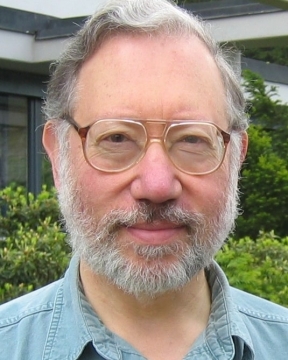
Louis Kauffman was born in Potsdam, New York on Feb. 3, 1945. He graduated from Norwood Norfolk Central High School in 1962 as valedictorian. He received the degree of B.S. in Mathematics from MIT in 1966. Kauffman was awarded a PhD. in Mathematics by Princeton University in 1972. He became Professor of Mathematics Emeritus at University of Illinois at Chicago in May of 2017.
Kauffman's research is in algebraic topology and particularly in low dimensional topology and knot theory, and their relationships with mathematical physics and natural science. His work in the early 1970’s on higher dimensional knotting and exotic structures on higher dimensional manifolds uses generalizations of branched covering constructions, and is fundamental to the topological understanding of these structures articulated via Brieskorn varieties and links of algebraic singularities. These constructions for non standard differentiable structures remain mysterious to this day, and are surely linked with fundamental physics – just as was the case for the manifolds studied by Brieskorn. Kauffman discovered a state summation model for the Alexander - Conway polynomial in 1980 and the bracket polynomial state model for the Jones polynomial in 1985 . These state models constitute the first direct application of partition functions to the construction of knot invariants. In the case of the bracket polynomial model, Kauffman showed that this state summation is a version of the Potts model in statistical mechanics - translated to knot diagrams. He discovered a two variable generalization of the original Jones polynomial that is called the semi-oriented or Kauffman polynomial. Since these discoveries his work has been primarily directed to the structure of the new invariants of knots and links. The bracket model led Kauffman, Murasugi and (independently) Thistlethwaite to proofs of the Tait conjectures about the topological invariance of number of crossings for reduced alternating link projections. His research in Virtual Knot Theory has opened up a new field of knot theory and has resulted in the discovery of many new invariants of knots and links. In particular, the state structure in the Kauffman Bracket was used by Mikhail Khovanov to create the theory of Khovanov Homology for knots, producing new and subtle invariants. Dye, Kauffman and Kaestner, using constructions of Manturov generalized Khovanov Homology to virtual knot theory and accomplished a new version of the Rasmussen invariant in that way. This gave rise to a determination of the 4-ball genus of positive virtual knots and Kauffman applied this result to obtain a corresponding determination of the reconnection numbers for knotted vortices corresponding to positive knots and links.
Kauffman’s work on knotoids with Neslihan Gugumcu and with Eleni Panagiotou has led to a number of applications to studies of open knotted long chain molecules and relationships with protein folding. The work on knotoids is of interest by itself for its applications to chirality of knotoids and other new invariants for them that are obtained by generalizing the original state summation model for the Alexander polynomial discovered by Kauffman in 1980. This Formal Knot Theory state summation now has a wide application to knotoids and to knots in the thickened torus, and is under intense scrutiny.
Kauffman’s work on Temperley-Lieb Recoupling Theory with Sostenes Lins led to new approaches, in joint work with Sam Lomonaco, to the Fibonacci model (Kitaev) for topological quantum computing. He has recently worked on representations of the Artin braid group related to the structure of Majorana Fermions and relations to the Dirac equation and to nipotent solutions of the Dirac equation in the sense of Peter Rowlands. He is presently working on specific problems about reconnection and chirality in knotted vortices and for knots in liquid crystals (ongoing work with Ivan Smalyuk).
Kauffman’s work in topology and mathematical physics is directly related to his work on foundations, diagrammatic systems, form and logic. He has written numerous papers on the idea of distinction in relation to form and mathematical form, the structure of replication in logic and biology, the structure of recursion and self-reference, fractals, quaternionic fractals and most generally the relation of sign and space in the sense of Charles Sanders Peirce and George Spencer-Brown. He has applied these concepts to graph theory and to knot theory, to quantum information theory and to other problems in topology.
Kauffman is the author of four books on knot theory (three in Princeton University Press and one in World Scientific Press), a book on map coloring and the reformulation of mathematical problems, Map Reformulation (Princelet Editions;London and Zurich (1986)) and is the editor of the World-Scientific 'Book Series On Knots and Everything'. He is the Editor in Chief and founding editor of the Journal of Knot Theory and Its Ramifications.
Kauffman is the recipient of a 1993 University Scholar Award by the University of Illinois at Chicago and he is the 1993 recipient of the 1993 Warren McCulloch Memorial Award of the American Society for Cybernetics for significant contributions to the field of Cybernetics the 1996 award of the Alternative Natural Philosophy Association for his contribution to the understanding of discrete physics, the 2014 Norbert Wiener Medal from the American Society for Cybernetics. He is the recipient of the Lester R. Ford Award of the Mathematical Association of America (1978) and the Lester R. Ford and Paul Halmos Award of the Mathematical Association of America (2015) in expository writing for articles with Thomas Banchoff (1978) and Allison Henrich (2015) in the American Mathematical Monthly. He is the recipient of the Bertalanffy prize for outstanding work in complexity thinking (2016). He is Past President of the American Society for Cybernetics (2005-2008) and a former Polya Lecturer for Mathematical Association of America (2008 2010). He was elected a Fellow of the American Mathematical Society in 2014. Kauffman writes a column “Virtual Logic” for the Journal Cybernetics and Human Knowing and he plays clarinet in the Chicago-based ChickenFat Klezmer Orchestra.
Full biography: https://www.flogen.org/sips2025/pdfs/Louis_Kauffman_Bio.pdf
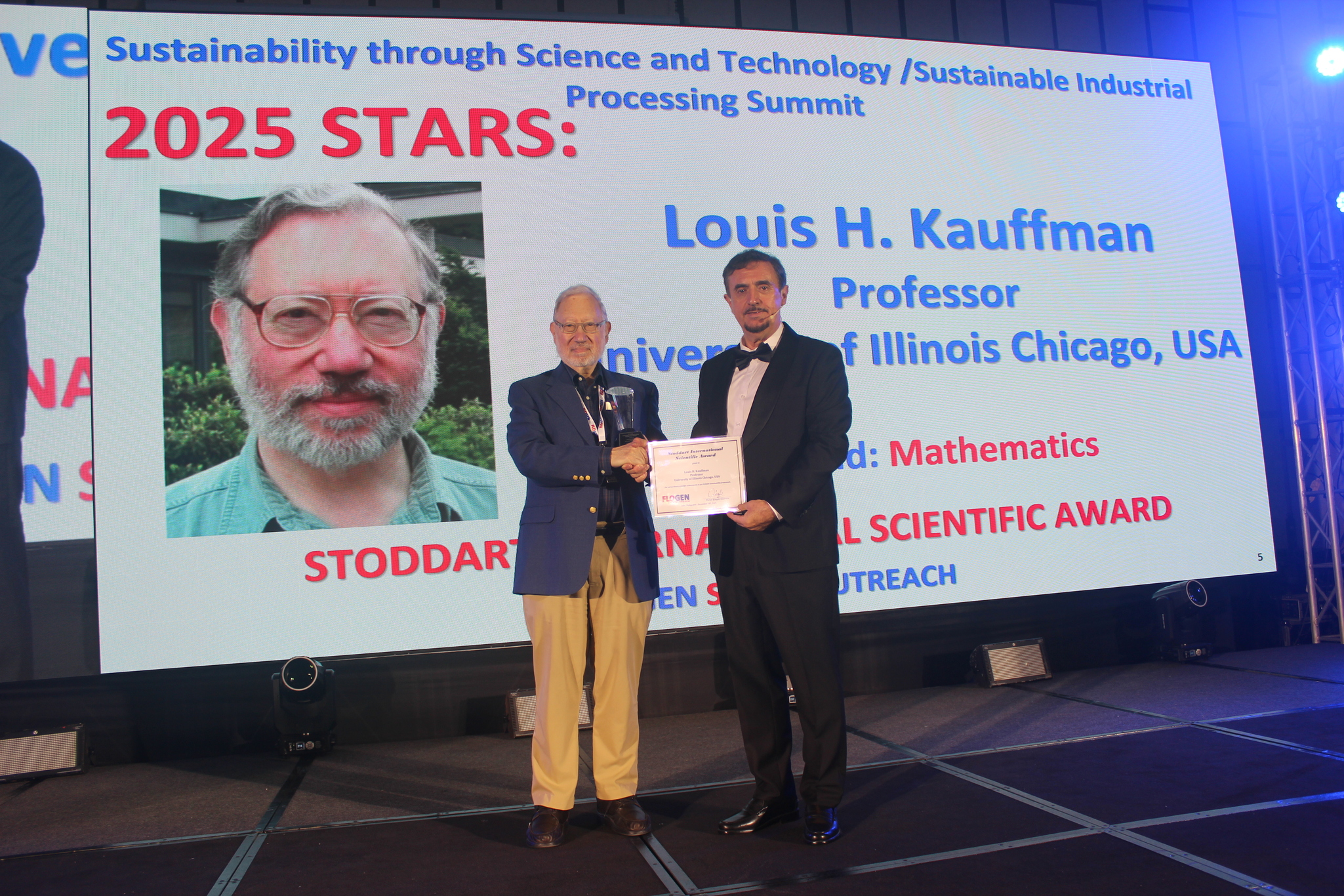
Dr. Louis Kauffman receiving the Stoddart International Scientific Award from Dr. Florian Kongoli at FLOGEN SIPS 2025
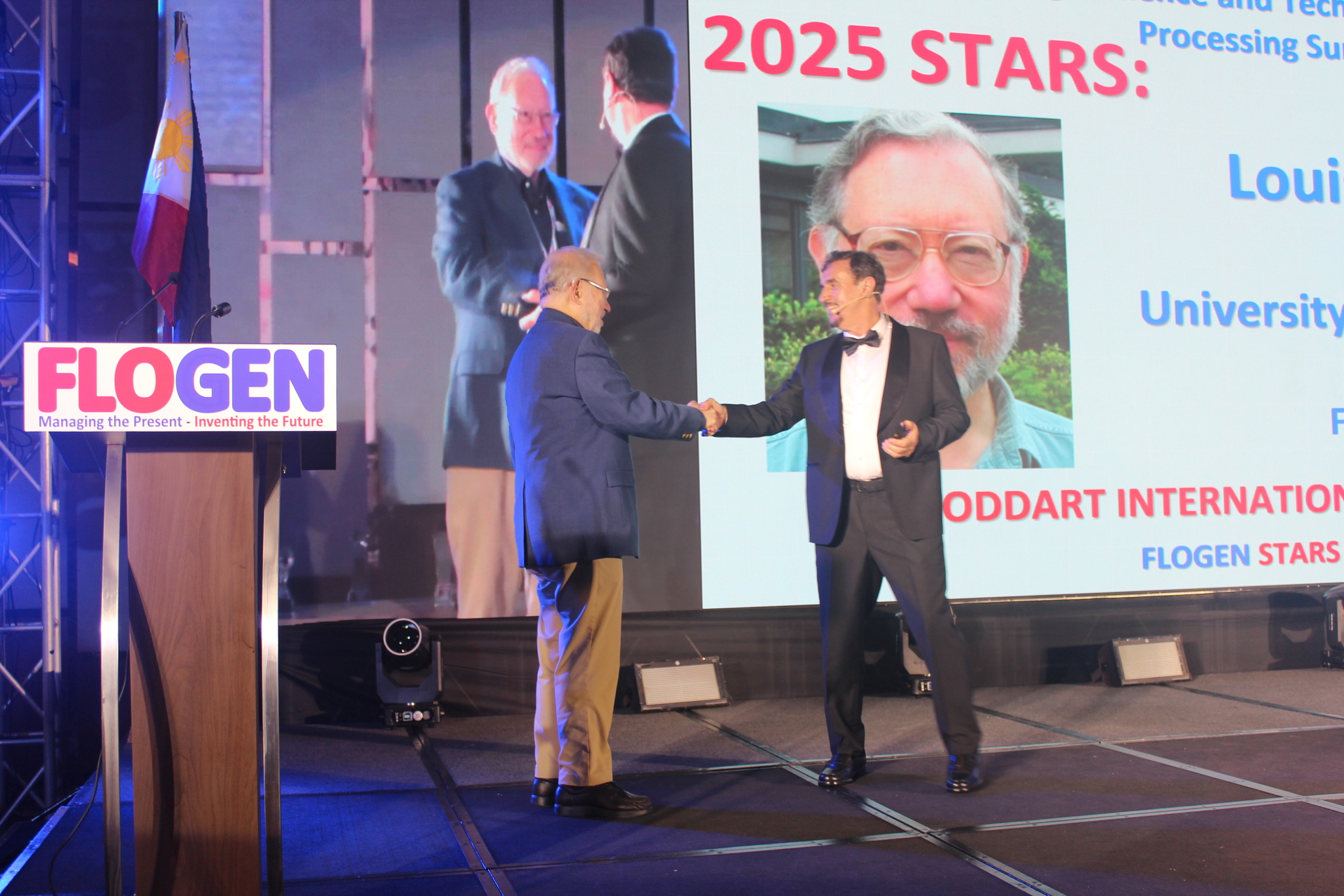
Dr. Florian Kongoli congratulating Dr. Louis Kauffman during the FLOGEN SIPS 2025 award ceremony
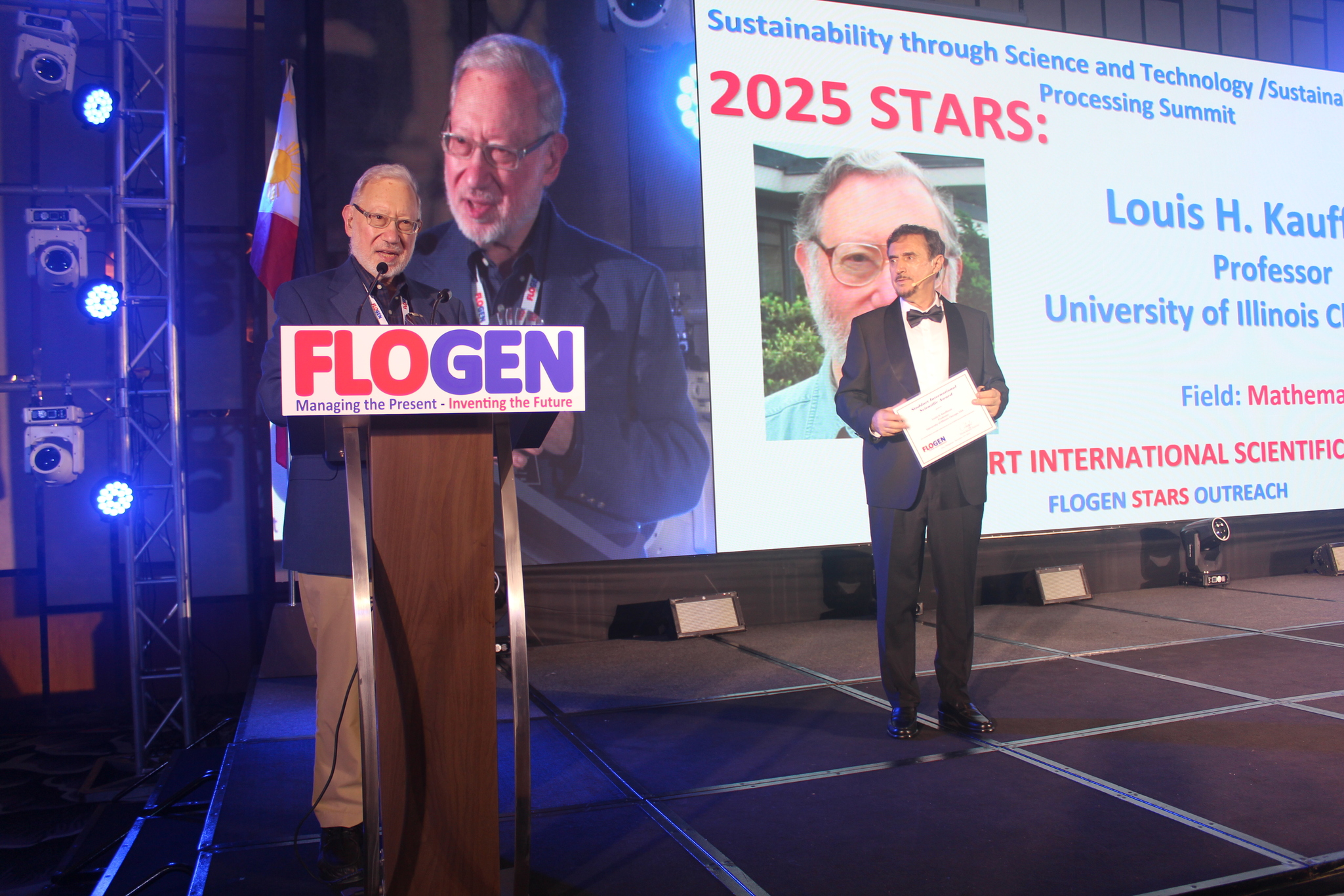
Dr. Louis Kauffman delivering an acceptance speech during the FLOGEN SIPS 2025 award ceremony
Video of the FLOGEN SIPS 2025 Award ceremony where Dr. Louis Kauffman won the Stoddart International Scientific Award. The ceremony was hosted by Dr. Florian Kongoli, chairman of FLOGEN.